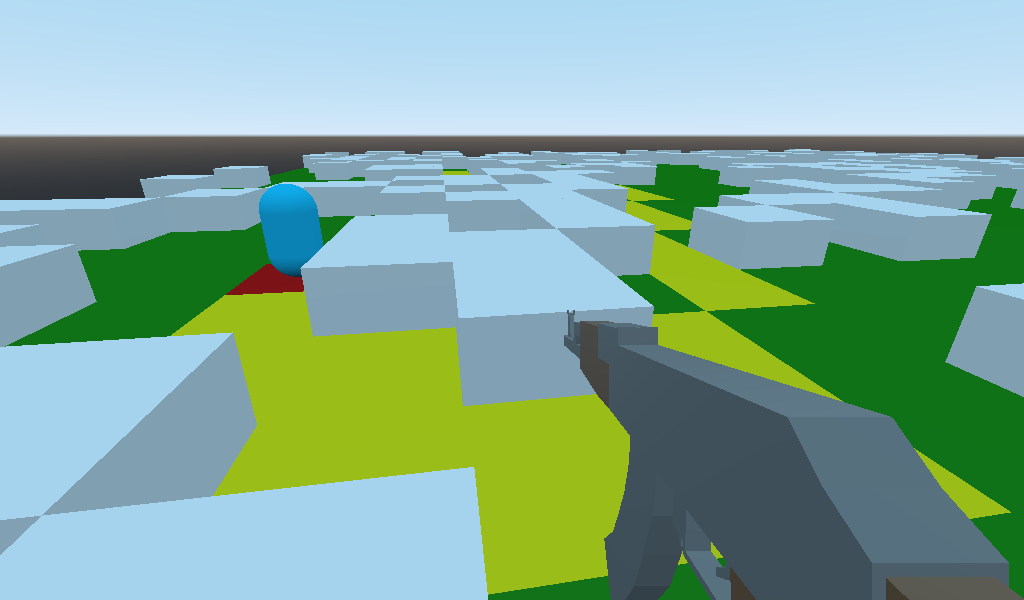
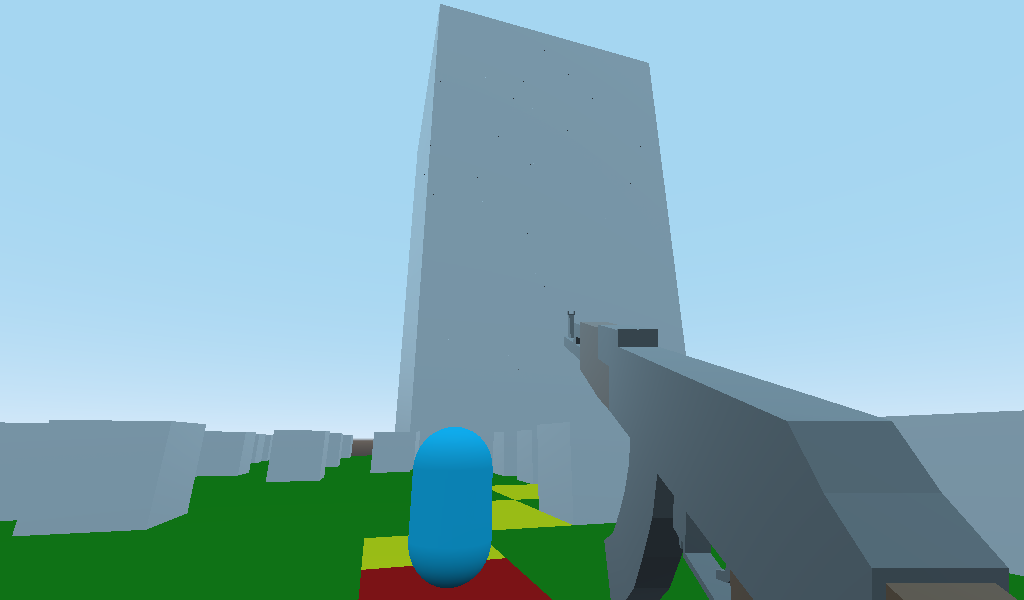
This simulator implements the A* pathfinding algorithm for AI bots to navigate an environment consisting of random blocks / walls and high-rise buildings.
Creating the map
To create the map, I had to first create a blank 2D grid map and then add blocks / walls to a random (x,z) node position.
func generate_map() -> void:
	# create blank map
	for x in range(map_size):
		for z in range(map_size):
			var key_position = Vector3(x, 0, z)
			create_floor(x, 0, z, key_position)

	# add walls
	for _x in range(floor(map_size * map_size * percent_walls)):
		var rand_num_x: int = rng.randi_range(0, map_size - 1)
		var rand_num_z: int = rng.randi_range(0, map_size - 1)
		var rand_key_position: Vector3 = Vector3(rand_num_x, 0, rand_num_z)
		create_wall(rand_num_x, 0, rand_num_z, rand_key_position)
Connecting the nodes
Next is to connect each node position to its surrounding nodes that isn’t a block / wall.
However there are a few edge cases to take account when connecting the nodes:
- Do not provide a path to a point that is completely enclosed in blocks
- Do not provide a path without jumping across a diagonal corner of two blocks
- Do not provide a path that cuts corners of blocks / walls
func create_astar_map() -> void:
	# loop through all grid cells
	for x in range(map_size):
		for z in range(map_size):
			var center_position = Vector3(x, 0, z)
			if not (center_position in gridmap_index.keys()):
				continue
			connect_surrounding_cells(center_position)

func connect_surrounding_cells(center_position: Vector3) -> void:
	for x in [-1, 0, 1]:
		for z in [-1, 0, 1]:
			if x == 0 and z == 0:
				continue
			var target_position = center_position + Vector3(x, 0, z)
			if not (target_position in gridmap_index.keys()):
				continue
			var source_index = gridmap_index[center_position]
			var target_index = gridmap_index[target_position]
			var diagonal_status: bool = has_diagonal_walls(center_position, target_position)
			if (diagonal_status):
				continue
			astar.connect_points(source_index, target_index, true)
Implementing the A* algorithm
import heapq
def astar(start, goal, graph, heuristic):
    """
    A* algorithm implementation.
    Args:
        start: Start node.
        goal: Goal node.
        graph: Graph represented as a dictionary of dictionaries.
        heuristic: Heuristic function.
    Returns:
        Path from start to goal.
    """
    # Initialize open and closed lists.
    open_list = [(0, start)]
    closed_list = set()
    # Initialize g-scores and parents.
    g_scores = {start: 0}
    parents = {start: None}
    while open_list:
        # Get node with lowest f-score.
        f_score, current = heapq.heappop(open_list)
        # Check if goal node is reached.
        if current == goal:
            path = []
            while current:
                path.append(current)
                current = parents[current]
            return path[::-1]
        # Add current node to closed list.
        closed_list.add(current)
        # Explore neighbors.
        for neighbor in graph[current]:
            # Ignore neighbors in closed list.
            if neighbor in closed_list:
                continue
            # Calculate tentative g-score.
            tentative_g_score = g_scores[current] + graph[current][neighbor]
            # Add neighbor to open list if not already in it.
            if neighbor not in [n[1] for n in open_list]:
                heapq.heappush(open_list, (tentative_g_score + heuristic(neighbor, goal), neighbor))
            # Update neighbor's g-score if new path is better.
            elif tentative_g_score < g_scores[neighbor]:
                index = [n[1] for n in open_list].index(neighbor)
                open_list[index] = (tentative_g_score + heuristic(neighbor, goal), neighbor)
            # Update parent and g-score.
            parents[neighbor] = current
            g_scores[neighbor] = tentative_g_score
    # No path found.
    return None
Generate the path for the bot
func generate_path() -> void:
	# generate two random points
	for gen_run in range(2):
		var has_two_points = false
		var rand_cell_pos: Vector3 = Vector3()
		while not (has_two_points):
			var rand_num_x: int = rng.randi_range(0, map_size - 1)
			var rand_num_z: int = rng.randi_range(0, map_size - 1)
			rand_cell_pos = Vector3(rand_num_x, 0, rand_num_z)
			if (gen_run == 1 and city_cellpath.start != rand_cell_pos and gridmap_cells[rand_cell_pos] == CELL.FLOOR):
				has_two_points = true
			if (gen_run == 0 and gridmap_cells[rand_cell_pos] == CELL.FLOOR):
				has_two_points = true
		if (gen_run == 0):
			city_cellpath.start = rand_cell_pos
		else:
			city_cellpath.end = rand_cell_pos
	var start_path = gridmap_index[city_cellpath.start]
	var end_path = gridmap_index[city_cellpath.end]
	bot_path_list = astar.get_id_path(start_path, end_path)
	# clear previous waypoint position list
	waypoint_pos_list.clear()
	# go through the path list
	for index in bot_path_list:
		var pos_x = gridmap_position[index].x
		var pos_z = gridmap_position[index].z
		var path_pos = Vector3(pos_x, 0, pos_z)
		if (path_pos == city_cellpath.start):
			city_gridmap.set_cell_item(pos_x, 0, pos_z, CELL.START, 0)
		elif (path_pos == city_cellpath.end):
			city_gridmap.set_cell_item(pos_x, 0, pos_z, CELL.END, 0)
		else:
			city_gridmap.set_cell_item(pos_x, 0, pos_z, CELL.LIGHT, 0)
		# create waypoint list
		waypoint_pos_list.append(gridmap_position[index])